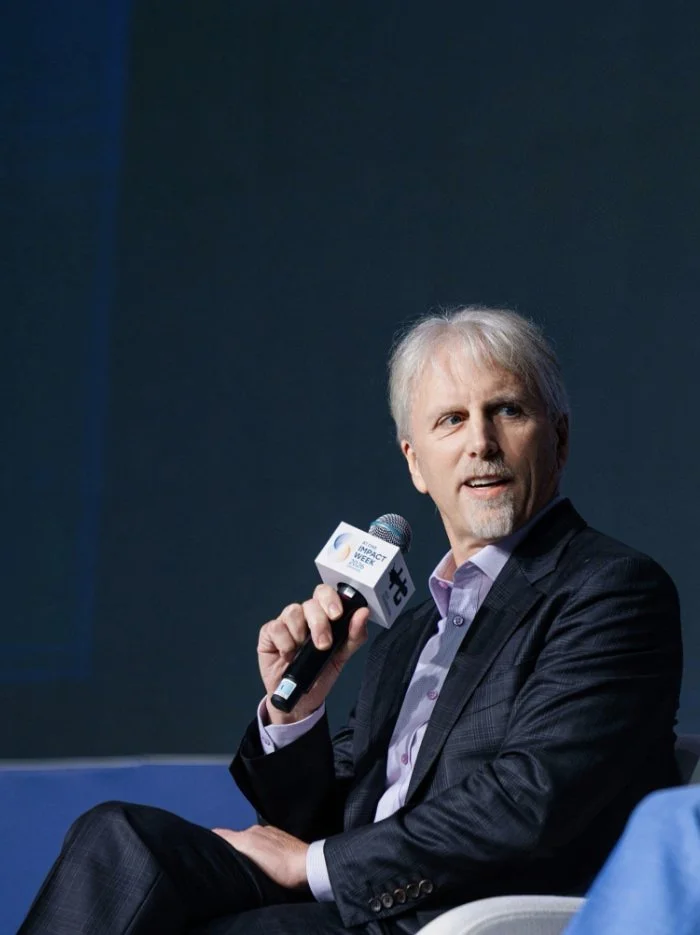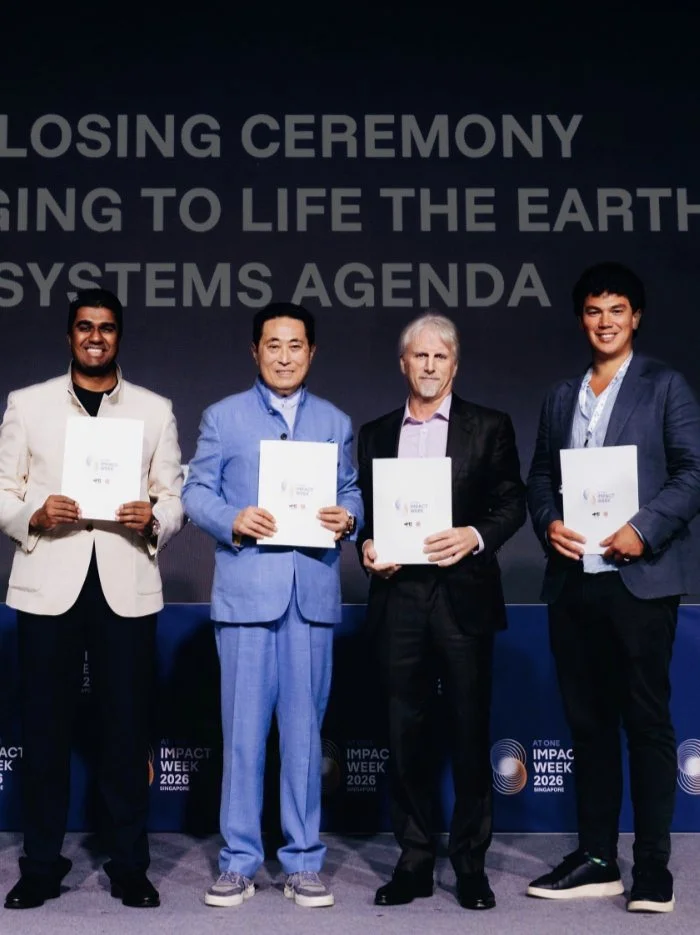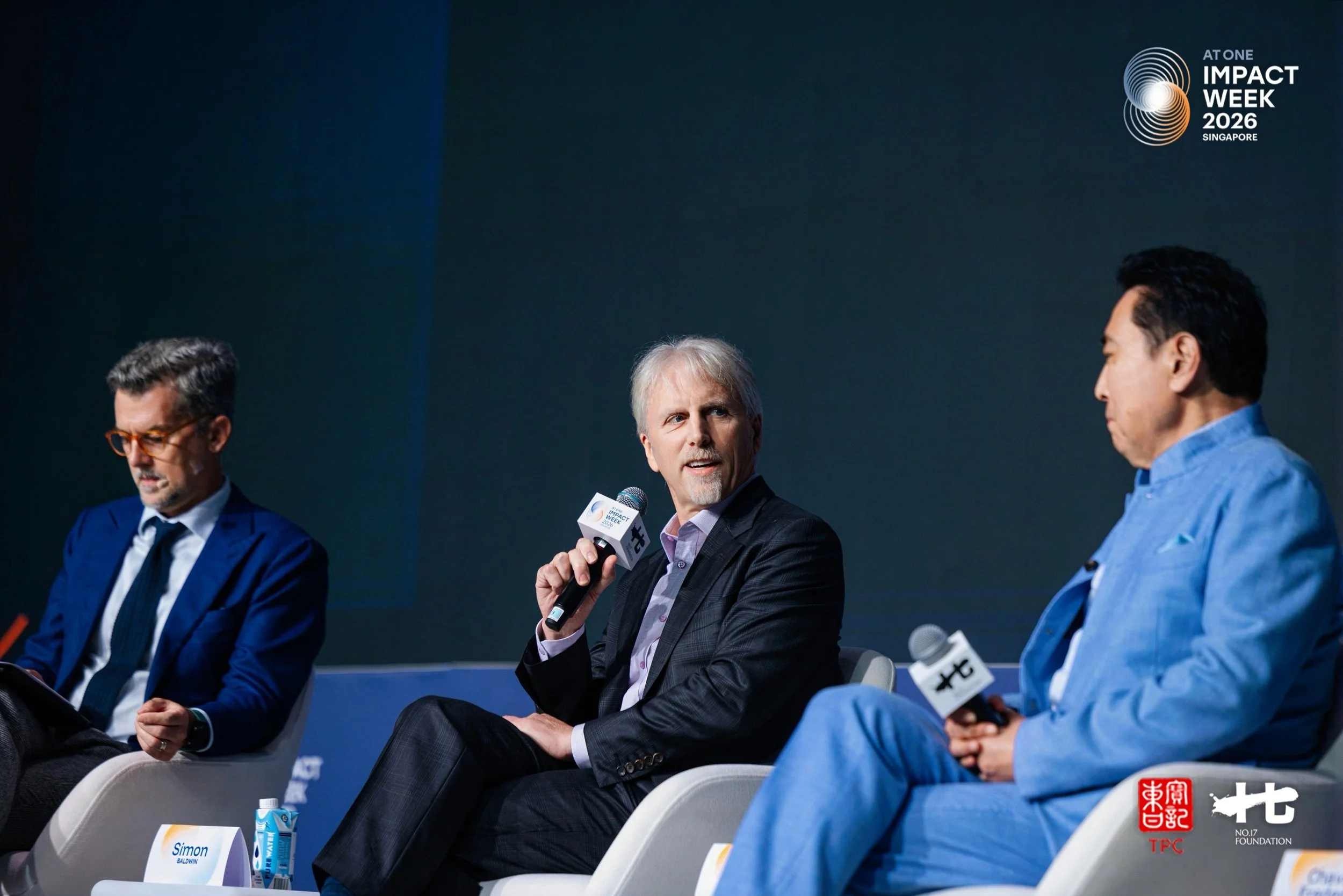
Simon Baldwin, Stephen Badger, and Chavalit Frederick Tsao at AT ONE IMPACT WEEK 2026 in Singapore
From 8–12 September 2026, Stephen Badger, Chair of the Economics of Mutuality Foundation, fourth-generation Mars Family Member and Board Member at Mars, joined Alastair Colin-Jones, Executive Director of Mutual Value Labs, and team members for AT ONE IMPACT WEEK in Singapore.
The global gathering, in its second year, was convened by TPC and NO.17 Foundation to accelerate the development of a well-being economy.
Across the week, our team spoke and co-hosted a series of workshops, roundtables, and conversations focused on a common challenge: how can businesses and capital work more effectively with communities and governments to create stronger local economies and restore the natural systems on which they depend?
Moving beyond isolated interventions
A central theme throughout the week was the need to move beyond individual projects.
Businesses, investors, philanthropic organizations, and governments are already investing substantially in challenges such as deforestation, rural livelihoods, supply-chain resilience, and nature restoration. Yet these efforts often remain fragmented – focused on individual commodities, transactions, or programs rather than the wider economic system of a place.
Through sessions focused on landscape regeneration, we explored a more coordinated approach: bringing together corporate sourcing, investment capital, locally defined priorities, enabling policy, and measurable outcomes for people and nature.
Discussions drew on the Restore Nature Discovery Phase we are leading with SecondMuse Capital, which is testing this approach across three landscapes in Indonesia: East Kalimantan, Simeulue, and Central Sulawesi. In each place, the work begins by understanding the relationships between the local economy, communities, businesses, and natural systems, before identifying a connected portfolio of opportunities capable of supporting wider transformation.
Participants explored the roles that different forms of capital can play, how businesses can help make landscape transition commercially relevant, and what shared infrastructure is needed to connect and scale place-based work.
Creating forest-positive economies
Alongside our participation in the main Impact Week program, Mutual Value Labs also co-hosted an executive roundtable with AFoCO (the Asian Forest Cooperation Organization), with contributions from Artha Networks.
The discussion brought together senior leaders from business, investment, government, and civil society to explore emerging opportunities for forest-positive economic development across Asia.
Rather than approaching deforestation as a challenge for governments or philanthropy alone, the conversation considered how corporate demand, investment, and regional development priorities could be better aligned. This included practical opportunities to strengthen rural livelihoods, build more resilient supply chains, and attract investment into economic models that support both communities and forests.
Leadership for meaningful growth
Our contribution to Impact Week also extended beyond place-based transformation.
In a workshop on purposeful leadership and meaningful growth, we invited business leaders to consider a fundamental question: what problems are your organization uniquely positioned to solve?
The session explored how businesses can look beyond short-term financial signals to better understand the value they create for different stakeholders. By applying their distinctive capabilities to meaningful challenges facing people or the planet, organizations can uncover new opportunities for positive impact and enduring commercial success.
This leadership perspective is essential to the wider work. Transforming systems requires new financial structures and cross-sector partnerships, but it also depends on leaders who can see their business as part of something bigger and act accordingly.
A new East–West partnership
The week also marked an important next step in this work.
The Economics of Mutuality Foundation and Mutual Value Labs announced a new partnership with TPC, NO.17 Foundation, and SecondMuse Capital to develop an East–West model for nature and shared prosperity.
Beginning with the three Indonesian landscapes we have already been working in, the partnership will connect place-based initiatives through shared methodologies, measurement systems, digital tools, investment architecture, and learning. The ambition is to enable each place to develop solutions rooted in its own economic, social, and ecological context while allowing insights to travel between Indonesia, the UK, the US, and other places in the future.
The Economics of Mutuality Foundation is serving as an anchor funder, supporting the shared infrastructure needed to connect and grow the work. Mutual Value Labs is contributing its expertise in mutual value creation, corporate engagement, measurement, learning, and field-building – including helping to connect investable local enterprises with the sourcing needs and capabilities of larger businesses.
From conversation to continued action
Impact Week created valuable space to test ideas, challenge assumptions, strengthen partnerships, and identify new opportunities for collaboration.
The task now is to carry that momentum forward: translating conversations into practical experiments, building the infrastructure that place-based transformation requires, and continuing to develop economic models in which business performance, community well-being, and a thriving natural world reinforce one another.
To learn more about this initiative, email hello@mutualvaluelabs.com