Healthy Money and Mutual Value in Modern Banking

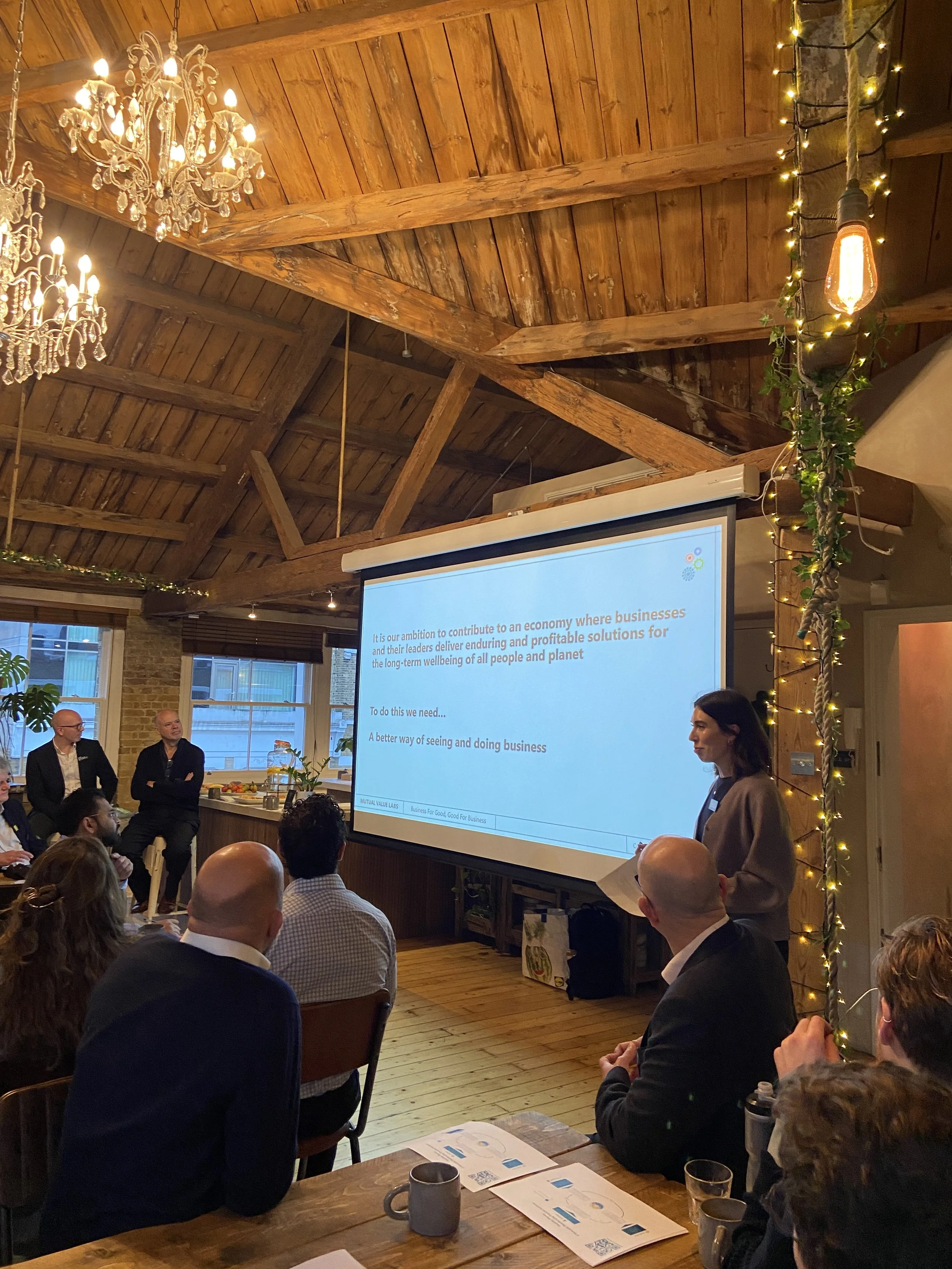
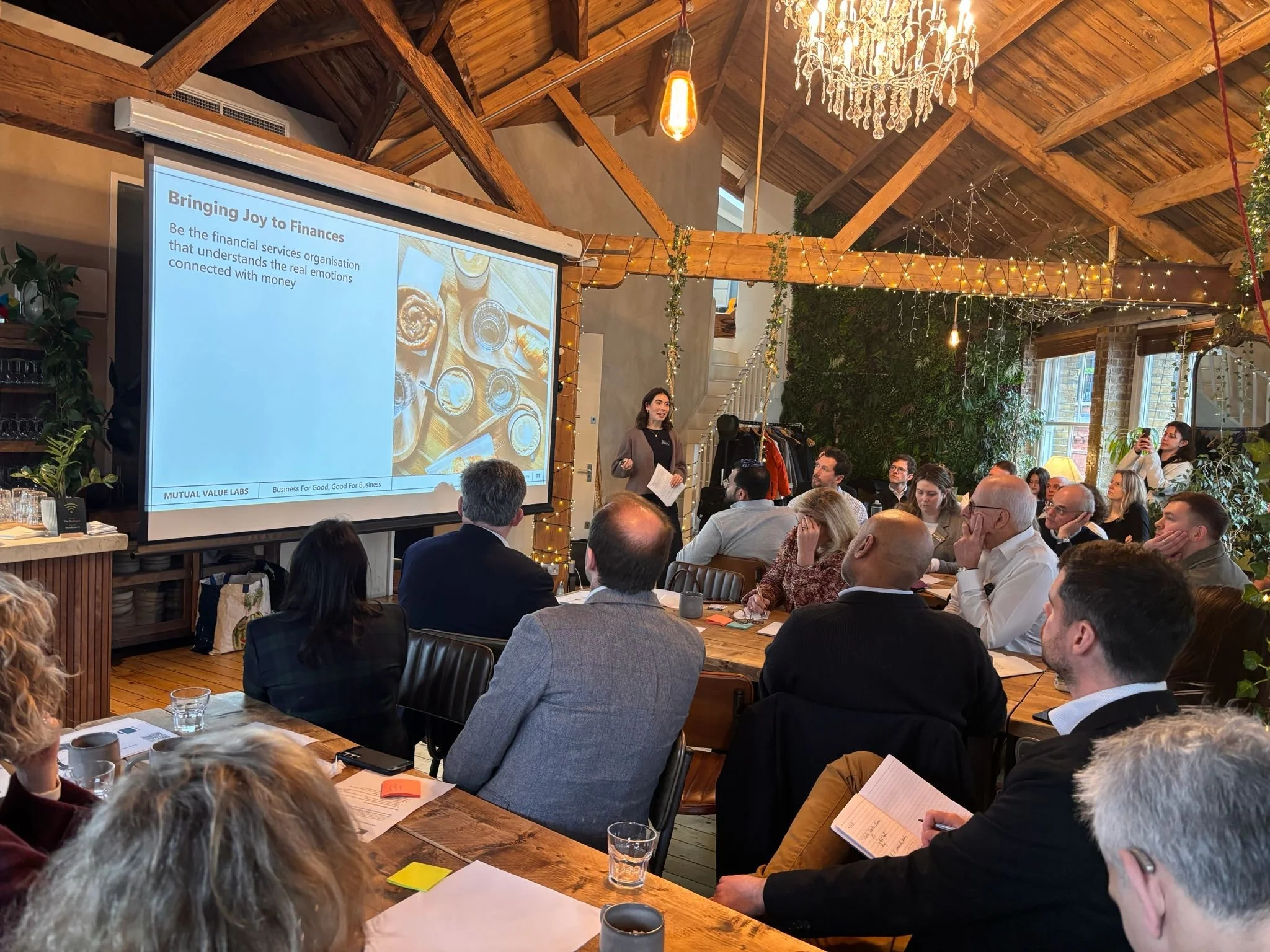
Participants at the Healthy Money Roundtable, hosted by Mutual Value Labs in London
Healthy Money and Mutual Value in Modern Banking
Our recent Healthy Money Roundtable convened a group of leaders from the financial services industry to grapple with a question that is becoming increasingly central to modern finance: what does financial wellbeing mean when banks are no longer just stewards of capital, but custodians of customers’ data, relationships, and financial experience? The discussion was candid and thoughtful – revealing a shared commitment to improving financial outcomes for people.
Hosted in London by Mutual Value Labs, the event brought leaders together from regulation, incumbent banking, professional services, fintech and civil society. A wide range of organizations were represented, including the Financial Conduct Authority, the Financial Times, Nest, the Skoll Centre for Social Entrepreneurship, the Impact Investing Institute, Lloyds Banking Group, the Financial Inclusion Commission, NatWest, Synapto Pay, Squire Patton Boggs, Slaughter & May, Mastercard, Kula, Deloitte, Visa, HSBC and J.P. Morgan.
The conversation was not about incremental product tweaks or surface-level commitments to the idea of financial wellbeing. Rather, it was an exploration of the shifts taking place in how power, trust and value creation are distributed across the financial system – and whether leading institutions can meaningfully adapt to the changes.






Rethinking a Bank’s Role in Its Customers’ Lives
The roundtable was anchored by a conversation between Alastair Campbell, former Group Head of Strategy at NatWest, now Chief Commercial Officer for 361 by Finca, and author of Healthy Money, and Liam Sharkey, Director of Growth at Mutual Value Labs. Campbell’s core provocation to the group was deceptively simple: Most banks still define themselves by their operating logic – balance sheets, deposits and loans – rather than by the role they play in customers’ lives. That misalignment, he argued, explains why so much value growth in financial services over the past decade has occurred outside of incumbent banks.
As Campbell framed it, the industry risks making similar mistakes we’ve seen made in telecoms: building technically complex infrastructure while allowing customer relationships, insight, and value creation to migrate elsewhere. In this scenario, banks remain essential but increasingly invisible “dumb balance sheets” sitting behind more intuitive, data-rich interfaces that customers actually use to manage their financial lives.
“Banks are extraordinarily good at telling you what happened last month, but remarkably poor at helping you understand what’s coming next month,” Campbell observed. “Financial health isn’t about explaining the past. It’s about enabling better decisions in the present and the future.”
Rethinking Trust in Modern Banking
A central theme that emerged across the room was trust – not in its traditional sense of safety and solvency, but as something more relational and forward-looking. As banks become custodians of vast quantities of behavioural and transactional data, the nature of trust is changing. Customers increasingly assume their bank will keep their money safe; what they are less convinced of is whether that same institution is acting in their long-term interest.
Several participants reflected on the paradox that, while trust in financial institutions is often said to be fragile, customer inertia remains extraordinarily strong. As one attendee put it, “More people get divorced than leave their banks.” The question, then, is not simply whether trust has eroded, but whether it has become passive, based on habit and switching costs rather than genuine confidence.
For incumbent banks, rebuilding trust may require moving beyond a reliance on financial education as the primary form of customer support. Today, most banks’ approaches to financial wellbeing focus almost exclusively on helping customers understand budgeting, saving and debt, implicitly placing responsibility for poor outcomes on individual behaviour. The discussion surfaced a shared critique of this mindset: education alone is insufficient if products, data architectures, and incentives continue to work against healthier financial decisions. Participants argued that trust is more likely to be rebuilt when banks design systems that support better financial behaviours by default.
Financial Wellbeing as Strategy, Not CSR
Participants were clear that financial wellbeing cannot sit at the margins of corporate strategy if it is to matter. Treating it as an add-on, a layer wrapped around fundamentally unchanged products, risks reinforcing the very mistrust banks are seeking to address. Instead, the roundtable explored what it would mean to take financial health seriously as a measure of performance that shapes propositions, data use, and success metrics.
This is where the Economics of Mutuality approach, central to Mutual Value Labs’ work, intersected powerfully with the discussion. Financial wellbeing was positioned not as a moral obligation detached from commercial logic, but as a driver of long-term, mutual value. Given banks’ uniquely regulated, holistic understanding of customers’ financial lives, choosing not to use that position to support stability, confidence and control is a strategic error.
The practical implications are significant and demand a reimagining of banks’ products and services. They point to a need for deeper architectural change, new forms of customer consent and control, and a willingness to measure success in terms that extend beyond product penetration or short-term profitability.
A Starting Point
If there was a shared conclusion, it was that trust in financial services will not be rebuilt through better messaging alone. It will be increasingly shaped by how institutions use data, design experiences, and support long-term customer outcomes. The roundtable was a reminder that the concept of financial wellbeing does not represent a soft agenda for easier times, but instead posits a hard strategic question for leaders willing to engage with its inherent complexity.
Many thanks to all of the participants who came and shared their experience and insights so generously.
If you would like to discuss this topic further, reach out to Liam.Sharkey@mutualvaluelabs.com