Leadership Needs the Insight of Imagination
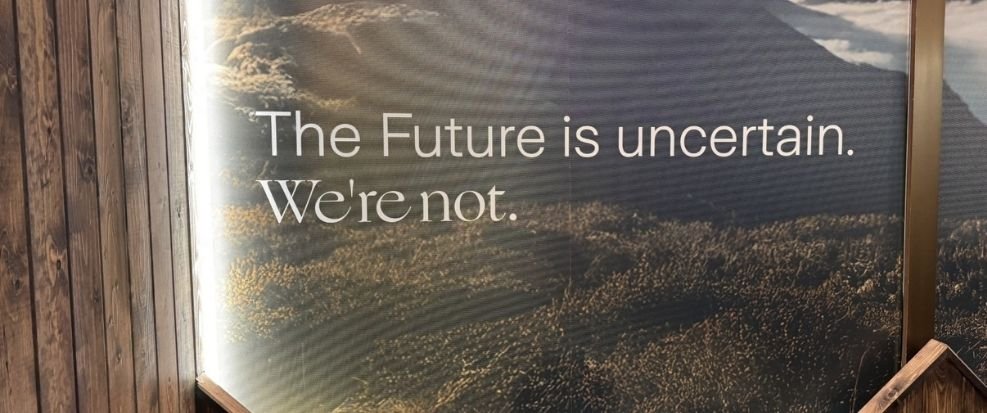
A Swiss insurance company's shop front ad at Davos 2026
Reflections by Alastair Colin-Jones, Executive Director at Mutual Value Labs
Walking down a street in Davos last month I was confronted by a huge ad on a shop front (one of the Davos ‘Houses’) bought, no doubt, at significant cost for the week. It was the work of a global Swiss insurance company.
It was striking, not because of its beauty or wit but because of its claim: “The Future is uncertain. We’re not.” At first, I laughed, then it dawned on me that it probably wasn’t meant to be funny. They really want to us to believe this.
And in 6 short words they cut to the heart of much of what must be dismantled in the business world…
A stubborn insistence on selling certainty. We’d all love to know where they found their crystal ball to deliver on this claim! Is what the world needs another Ponzi scheme playing on the volatility and complexity of our times?
A worrying assumption that certainty is actually what we need. That we believe we can think ourselves out of every predicament and that as our data mounts, the likelihood of success increases. Yet, even as our algorithms churn and hit overdrive, we only seem to dig deeper into our present crises.
A wilful blindness to hide from what our age of uncertainty actually requires of us. The biggest mistake is to hide from the inevitability of our uncertainty rather than embrace the questions it poses to each of us.
Leadership needs a retreat from certainty and an embrace of what I want to call the ‘insight of imagination’: a synthesis of head and heart, animated by the confession that a better future only lies outside the assumptions that constrain what we currently see.
The alternative to today’s financial capitalism and neo-liberal economics is yet to be fully imagined and the task is fundamentally one of imagination: spiritual, moral, and intellectual.
We often refer to the ‘Copernican Revolution’ in our work, using this moment of history as a reminder of how scientific brilliance and insight can restructure the foundations of society and self-understanding. Yet, I have come to recognise that today’s bias and thirst for breakthrough knowledge hides an important reading of what the insight really is.
Though Copernicus was undoubtedly a genius, by all accounts, a polymath; his insight in this moment was not ultimately in scientific method or mathematical genius. But in something rather less celebrated: his courageous willingness to question the assumptions of the day, the frames and narratives that maintained the Renaissance status quo.
His true genius, it seems, was his insight of imagination.
“Leadership needs a retreat from certainty and an embrace of what I want to call the ‘insight of imagination’: a synthesis of head and heart, animated by the confession that a better future only lies outside the assumptions that constrain what we currently see.”
Imagination is what we need to see what could be, the alternatives and the possibilities; and in the end, it will provide us the language needed to describe the depth of a different reality.
Our present economic system rests on the beliefs that limitless growth is necessary, that competition is the default, that what is valuable can be valued and reduced to a price, that human worth is measured by productivity or consumption, and that success is determined by a salary and a title.
Many purported solutions to our current system, like ESG, remain firmly entrenched in these assumptions. Our imaginations are colonised by the narrative of the status quo. Somehow, we are not accessing the type of imagination that Copernicus embraced, to have the true insight that sees beyond the dominant and immanent frame.
A temptation would be to think that the insight of imagination is an exercise in detached dreaming or wishful thinking. It is not. Paradoxically, the insight of imagination demands courageously wrestling with, and being firmly, in the present reality.
It is a deeper reading and seeing of the present and ultimately an awakening to the depth of reality that combines with a hopeful vision of something better. To imagine in this way, we will need the language and friendship to articulate, debate and discuss and ultimately disclose and reveal the alternatives.
When it comes to language, many of us participate in a discourse – and I am complicit in this – that possesses a vibrant moral vocabulary, but we fail to inhabit our words. We can say “mutuality”, “justice”, “freedom”, “rights”, “community” – and yet still live our lives mastered by domination, accumulation, consumption, and competition. And this is why it is so hard to shift the status quo. We must confront our complicity in order to inhabit an alternative.
It starts with inhabiting the words we use to make them real. Then we must also seek to inhabit literal alternatives; create the living labs of experiments that are signposts to the imagined alternative.
And so, to bring it home and directly into the work of Mutual Value Labs, this is why with SecondMuse, NO.17 Foundation , and TPC (Tsao Pao Chee) we will use the Discovery Fund that we announced at Davos to create small and certainly imperfect experiments of a wellbeing economy that has mutuality driving the pursuit of human and environmental flourishing.
Are we certain that this will be successful? Absolutely not. Are we certain that we know exactly how to pull this off? It’s a no. Are we certain that this is the next step that is required for us to unlock the insight of imagination and inhabit our words and world in a way that makes a wellbeing economy a faint possibility? Absolutely certain.
The future is uncertain. And so are we. But in this work, we know that our relationship to the future economy is not one that first demands knowledge and certainty, but instead imaginative inhabiting that is both proximate and wise – and if it is nothing more than a signpost to something more and better, we will be satisfied.