How Mars and Coles Innovated Retail Displays Through the Lens of Mutual Value Creation
April 2026 | Case Study
Innovation in business is often framed as the pursuit of something new. But in practice, many valuable opportunities come from a better understanding how existing systems actually work.
When organizations take the time to understand the pressures, constraints, and incentives of their partners, they often uncover inefficiencies that are easy to overlook from a distance. Addressing these doesn’t necessarily require breakthrough ideas, but a shift in perspective – moving from isolated problem-solving to a more connected view of how value is created.
In this case, a collaboration between Mars Wrigley Australia and Australian retailer Coles, demonstrates how a closer look at operational realities led to a redesign of a routine process. The outcome was improved execution, reduced waste, and a 14% sales uplift. The environmental and social benefits were real, but they were not the primary objective –they emerged as a byproduct of solving a shared problem more effectively.
By redesigning promotional displays used in supermarkets, the companies reduced waste, improved store operations, and strengthened their strategic partnership.
The initiative illustrates how the Economics of Mutuality approach can guide businesses to create value for multiple stakeholders – delivering measurable business outcomes while improving environmental and social impact.
Seeing the Problem Differently
The collaboration began when Mars Wrigley Australia was facing declining profitability in its “bitesize” confectionery category. Promotions are essential for driving sales in the category, and these often rely on temporary cardboard displays in retail stores.
However, conversations with Coles revealed a deeper issue: the displays themselves were creating operational inefficiencies and waste.
Frequent display changes required significant labor from store teams, while large quantities of cardboard were discarded after each promotional cycle.
For Alexandra Sciacca, Strategic Demand Director at Mars Wrigley Australia, understanding the challenge required seeing it firsthand. Sciacca – an alum of the Economics of Mutuality program Leading With Purpose – decided to spend time working in Coles stores helping build and dismantle displays.
“It became clear how much cardboard waste was generated and how much manpower it required to constantly manage display changes,” she explained.
Rather than viewing this purely as a cost problem, Alexandra reframed it as a mutual value opportunity: if Mars could help solve Coles’ operational and sustainability challenges, both companies could benefit.
Rethinking the Innovation Process
To tackle the issue, Mars assembled a cross-functional team to rethink how promotional displays could be designed and used.
The team approached innovation differently from typical commercial processes. Instead of starting with profitability, they focused first on environmental outcomes –asking how the sustainability of in-store materials could be improved while also simplifying retail operations.
“I think a lot of innovation processes typically come up with an idea and only later ask whether it can deliver the impact they expected,” Alexandra said. “We focused on getting better inputs earlier to understand whether the solution would actually deliver the sustainability impact we were aiming for.”
This outcome-first mindset helped the team experiment more freely and evaluate ideas against a clear goal: reducing waste while improving operational efficiency.
As Andrew White, Field Sales Director at Mars Wrigley Australia, reflected:
“We were able to be quite disruptive and fast paced in trying to create something that would have maximum impact. Because we had such a clear vision, we built momentum and made decisions quickly.”
Designing a Circular Solution
Working with external partners including 5P Group and Plastic Bank, the team developed two key innovations.
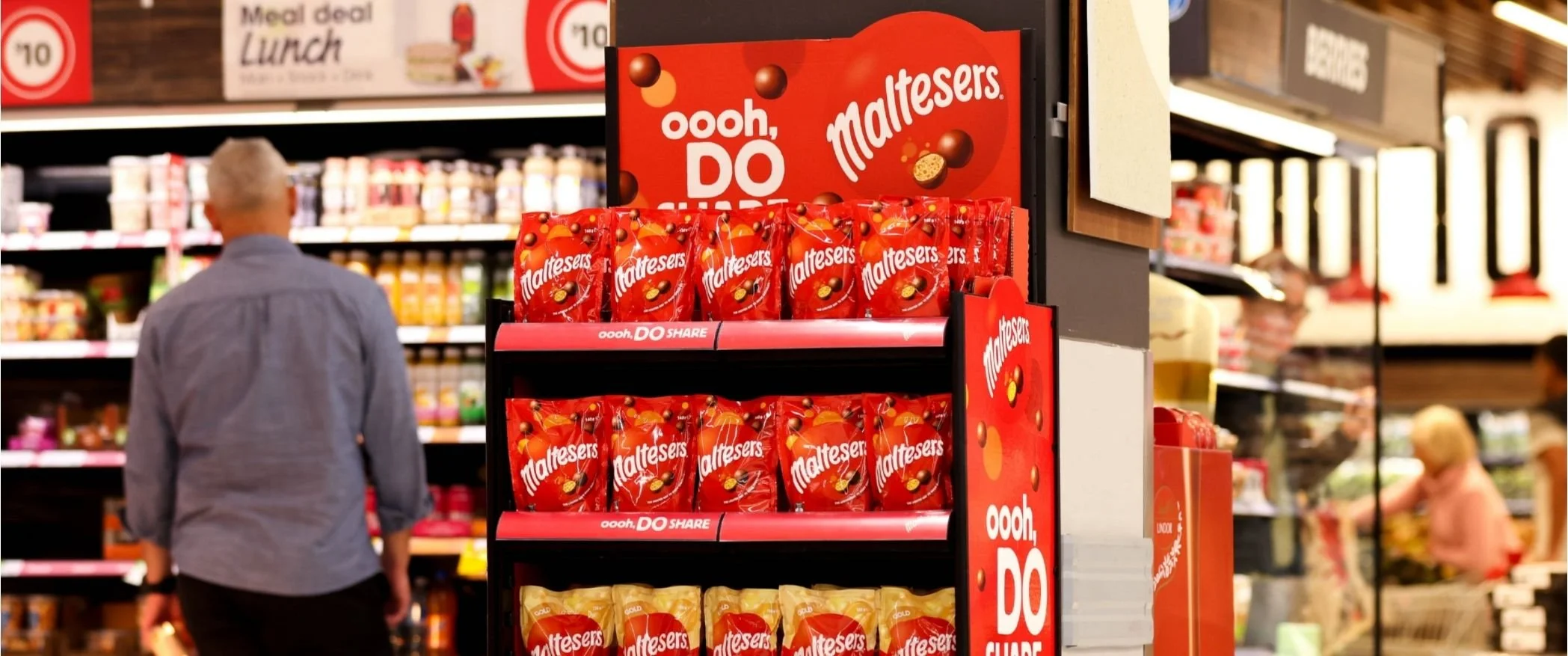
First, Mars redesigned its secondary packaging so that shipping boxes could double as shelf-ready displays, eliminating the need for separate promotional materials.
Second, the team created modular display units made from recycled plastic, designed to remain in stores longer and reused across multiple promotional cycles.
The recycled plastic used in these displays includes material collected through Plastic Bank’s programs, which provide income opportunities for communities collecting ocean-bound plastic.
Developing this solution required close collaboration with Coles and overcoming traditional barriers in retailer–manufacturer relationships, where permanent display assets are often avoided to maintain merchandising flexibility.
Delivering Measurable Impact
The collaboration delivered measurable results across sustainability and commercial performance.
Environmentally, the circular display system significantly reduced waste in the retail value chain. The modular displays repurpose eight tons of plastic, while the shift to stackable shelf-ready displays is expected to eliminate 72 tons of cardboard waste from Coles’ value chain.
Lifecycle analysis also shows that the modular recycled displays reduce carbon emissions by 34% compared with traditional cardboard displays.
The initiative also created social impact through Mars’ partnership with Plastic Bank. Plastic used in the displays was collected by communities in the Philippines, providing income opportunities and social benefits to 61 collection members involved in the program.
Commercially, the impact was equally strong. A four-week trial across 51 stores showed:
14% sales uplift from stackable displays
11% uplift from modular displays (compared with 6% from cardboard displays)
Following the successful trial, Coles rolled out the new displays across 700 stores nationwide.
For Via Lavdas, Head of Trade at Coles, the collaboration highlighted the value of working differently with suppliers.
“The successful launch of the display unit and the positive feedback from our store teams demonstrated the value of this collaboration,” she said. “It’s a great example of how we can win together.”
A Model for Mutual Value Innovation
By applying the principles of the Economics of Mutuality – focusing on stakeholder outcomes, prioritizing impact, and building social capital – Mars and Coles transformed a waste problem into a source of shared value.
As Sciacca reflected:
“Innovation with retailers doesn’t have to be on product. It can be on the operational side of their business too – but you have to be willing to listen to their tensions and immerse yourself in them.”