“Designing the Future We Cannot Yet Fully See”
April 2026 | Masterclass
Combining the Three Horizons framework with the Economics of Mutuality approach
In a recent masterclass co-hosted with Carly Santer – former Impact Officer at Bayer UK and Founder and Director of Future Delta – we invited a group of business leaders to step back from their day-to-day work to explore a question:
What does it take to move from purpose-led ambition to system-level transformation?
The session brought together leaders interested in translating purpose into action – particularly in complex areas such as climate, health, and societal wellbeing.
Through a combination of Bill Sharpe’s Three Horizons Framework and the Economics of Mutuality approach to value creation, participants were invited to look at the challenge through a different lens.
What emerged is that many organizations are already pursuing sustainability initiatives, new partnerships, and evolved business models…Yet these efforts often remain peripheral. The system continues to privilege a narrow definition of value, and in doing so, reproduces itself.
Seeing Across Horizons
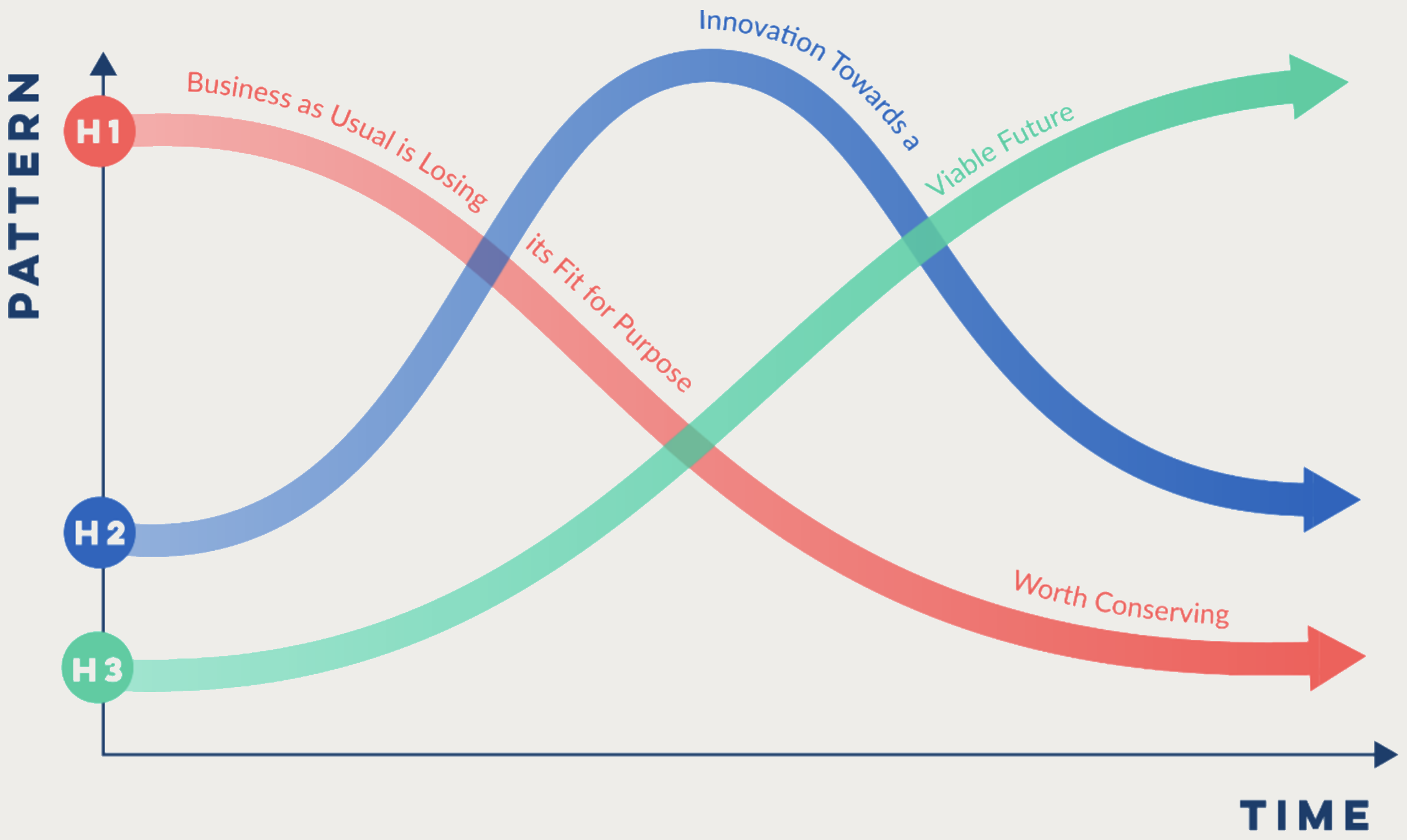
The Three Horizons and how they evolve over time
This work is licensed under the Creative Commons Attribution-ShareAlike 4.0 International (CC BY-SA 4.0). Credit: Bill Sharpe, Leaders Quest, Future Stewards, H3uni.org (https://h3uni.org/).
Simplified and adjusted for the purposes of this communication.
Many organizations today face a paradox. On the one hand, they must operate effectively within the current system – delivering performance, managing resources, and meeting stakeholder expectations. On the other, the challenges they face – from climate change to social inequality – require fundamental transformation.
Traditional strategic tools often struggle with this tension but the Three Horizons framework provides a way to hold this complexity:
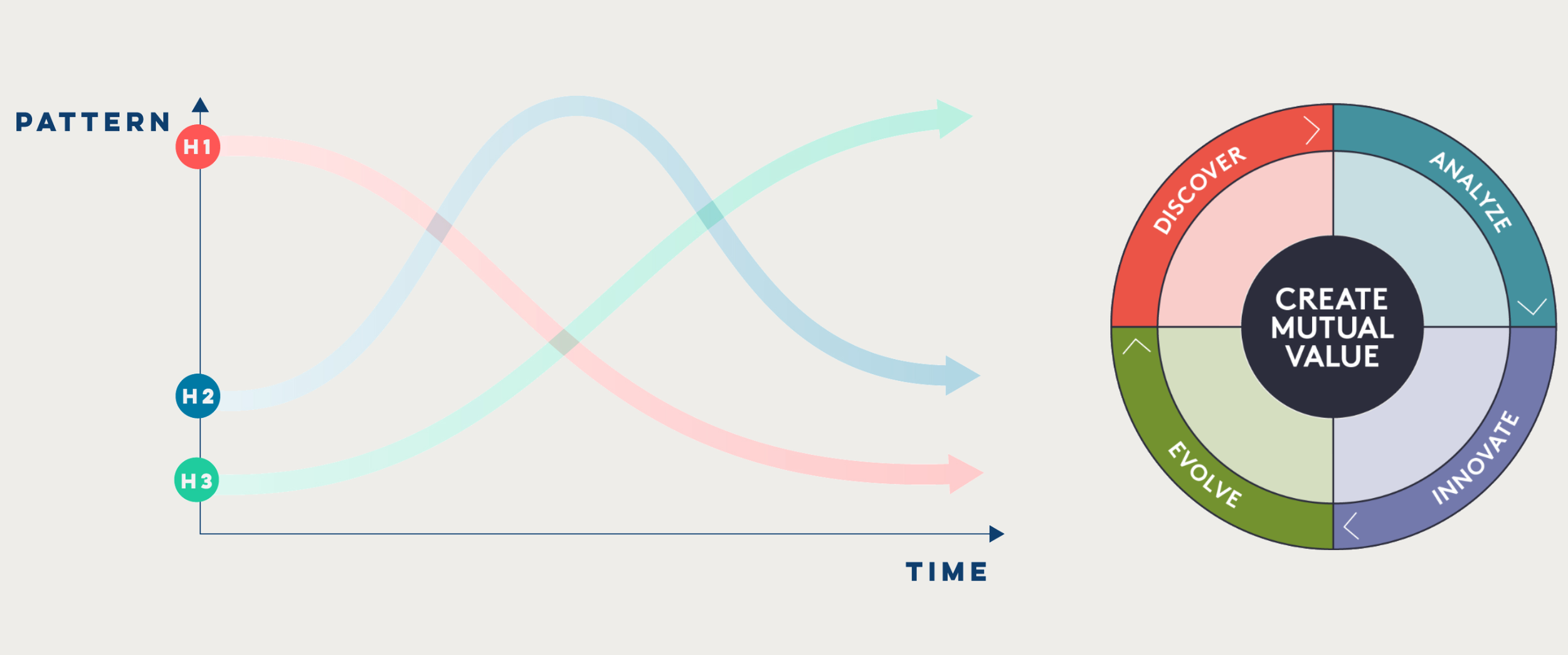
Horizon 1: the current system – optimized, embedded, and financially driven
Horizon 2: emerging responses – new ideas and experiments that do not yet fit
Horizon 3: patterns of a different system – already visible, but not yet established
These horizons often coexist in the present: what makes Horizon 1 successful can constrain Horizon 2. What emerges in Horizon 2 can appear unjustified through a Horizon 1 lens. Horizon 3 is often present, but faint and easily dismissed before it takes hold.
Attention Shapes Transformation
A central insight from the session was simple: transformation depends on what leaders choose to pay attention to. Early signals of change already exist in marginal initiatives, evolving practices, and shifting expectations. But without the right focus, they remain peripheral.
The challenge is not only to innovate, but to notice and legitimize what is emerging, even when it does not yet conform to existing metrics. Frameworks like Three Horizons create a space where leaders can experiment with new narratives about the future.
They help teams investigate what is holding the current system in place, while also identifying the signals of transformation that already exist today. This process can be both analytical and hopeful.
The Role of Mutual Value Creation
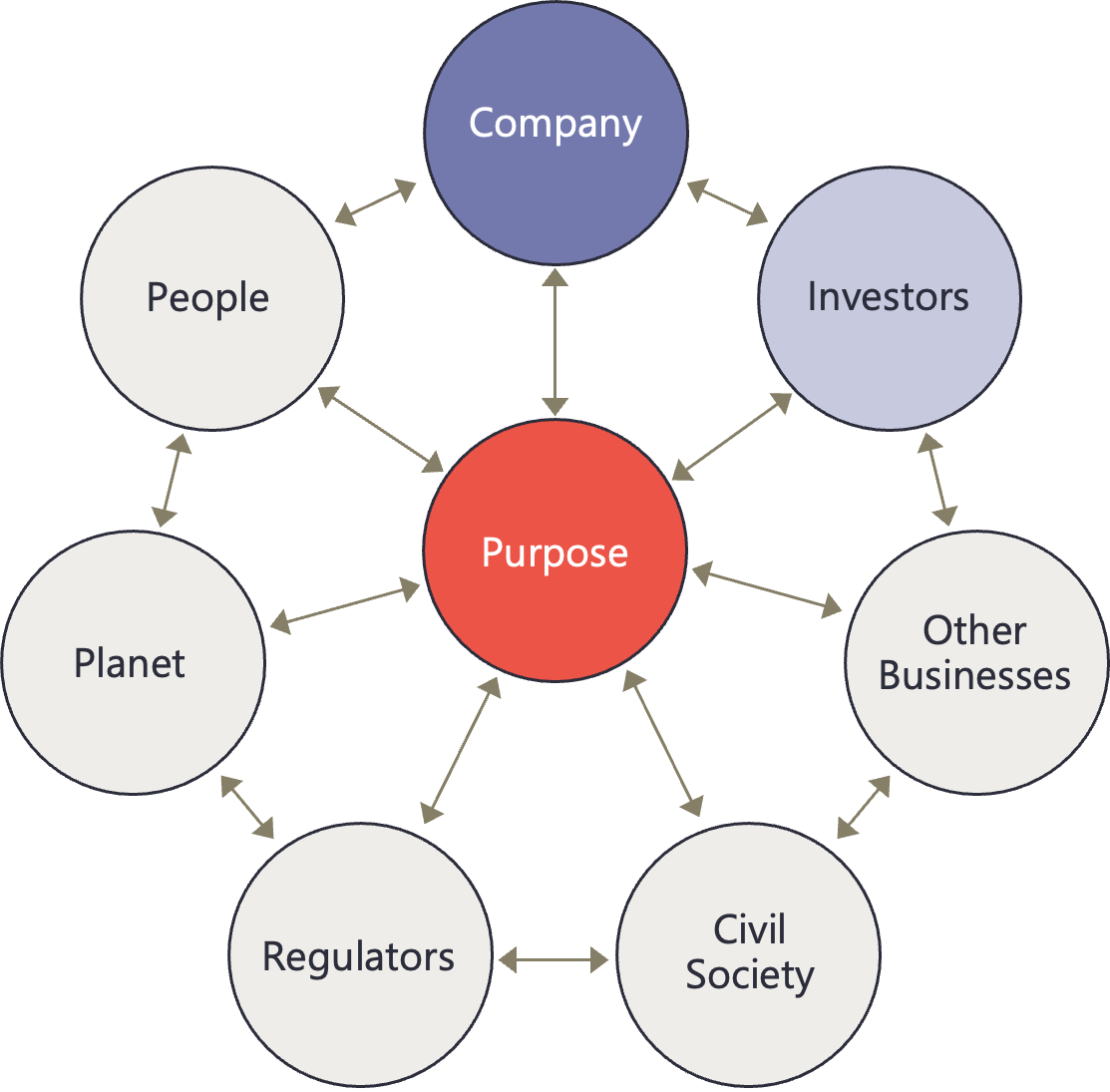
Businesses and stakeholders co-create profitable and enduring solutions to social and environmental challenges. Financial performance and positive impact reinforce each other, generating benefits that are proportionate and sustained over time.
When used together, the Economics of Mutuality and the Three Horizons framework offer leaders both a compass and a map.
Economics of Mutuality provides the compass: a clear orientation around purpose and mutual value creation.
Three Horizons provides the map: a way to understand how transformation unfolds over time.
Together they help organizations answer three critical questions:
How does the current system shape the way we operate today?
Where are the innovations that point toward a different future?
What does the future system we truly want actually look like?
By exploring these questions collectively, organizations can begin to identify practical pathways toward systemic change.
Continuing the Exploration
Rather than offering a single answer, the discussion pointed to the need for space to explore questions more deeply.
To support this, we have developed a facilitated half-day workshop focused on recognizing under-valued sources of mutual value, particularly in Horizon 2.
The workshop invites teams to explore a simple but powerful question: what forms of value are currently recognized in the system and which ones are overlooked? Using the Three Horizons lens, combined with the Economics of Mutuality’s practical approach to mutual value creation, participants start by examining how today’s organizations tend to prioritize financial value creation, often overlooking other forms of value for people, communities, and the environment.
Participants leave with:
- Alignment on which forms of value are most critical to long-term resilience
- Clarity on the barriers preventing these from being recognized
- Actionable next steps to protect and grow these sources of value
The aim is not to introduce new initiatives, but to see more clearly what is already there and act with greater intention.
If you’re interested in the workshop, email Liam Sharkey at Liam.Sharkey@mutualvaluelabs.com.
To stay up to date with future masterclasses and events, sign up for our newsletter.