Wandering Between Worlds

Georgia O'Keeffe (1930), Black Mesa Landscape, New Mexico / Out Back of Marie's II
Reflections by Alastair Colin-Jones, Executive Director at Mutual Value Labs
It is a strange moment in more ways than one.
At once aware we are in the throes of yet more violence orchestrated by world “leaders” tormenting parts of the world as if life and livelihoods are their playthings.
And yet, I sit at a desk in Geneva; sunshine streaming through the window, looking at snowcapped mountains and listening to the sounds of spring, pregnant with life.
And more personal still, in a moment of calm before a storm of sorts, with my wonderful wife also pregnant with life, today at 40 weeks we await on tenterhooks the arrival of our third child.
With meetings finished and projects handed over ahead of my paternity leave, I’ve found myself with the uncommon luxury of time to think, feel, read, and write.
The words of Matthew Arnold’s profoundly honest and beautiful poem, Stanzas from the Great Chartreuse, set in the very Alpine mountains I can see from my desk, seems to capture a sense of the moment we find ourselves in:
“Wandering between two worlds, one dead, The other powerless to be born, With nowhere yet to rest my head, Like these, on earth I wait forlorn.”
The poem as a whole is a journey along a threshold, a “mule track” as he describes it, that is “high in the valley”; a path that is neither at the heights of a mountain top nor in the depths of a valley, somehow neither here nor there. It is a moment of grey, of doubt at the threshold between life and death, certainty and uncertainty, past and future. And as he looks at either side, he is at once both drawn into and repelled by the worlds he sees.
Is it possible that Arnold’s message could be shaped into a framework for thinking through our current economic threshold, standing between the dying of our neo-liberal, financial capitalism and an unknown alternative “New Economy”? We have had a go...
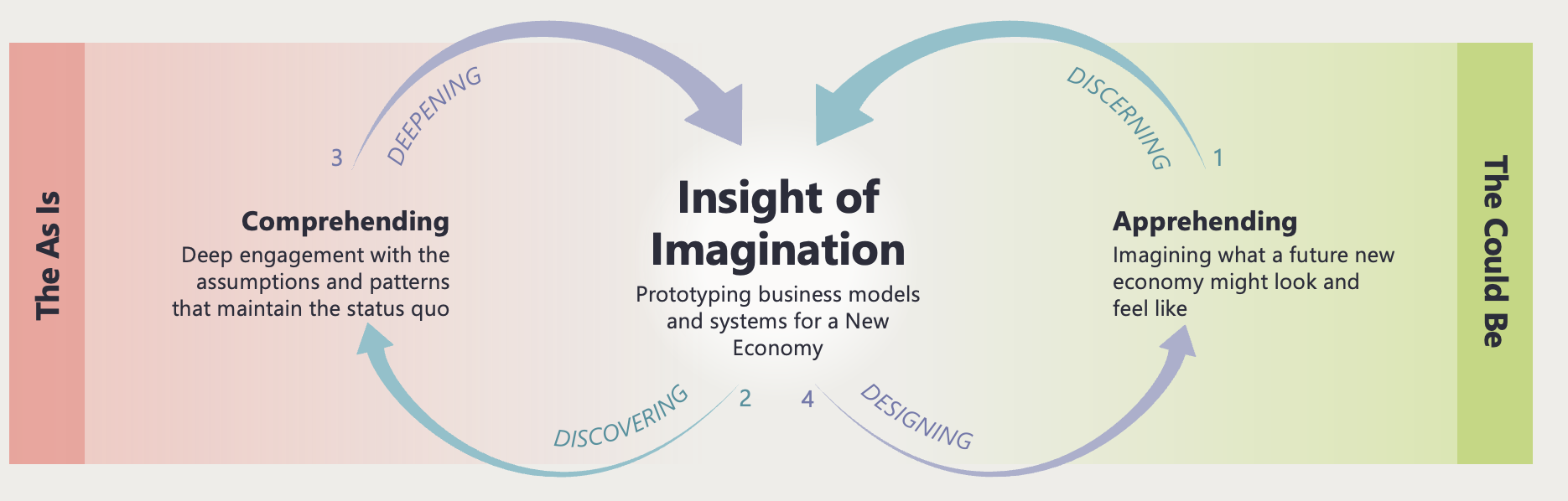
This framework builds on the ideas I shared in my previous article, “Leadership Needs the Insight of Imagination". The way to read it is not as a process per se, but as a pattern; a loop for zooming in and zooming out again, for learning and unlearning, for knowing and then doubting again. The pattern might be articulated something like: discerning from a future longed for but not yet here, flowing to a discovering of the ways it is and is not nascent in the present, and on to a deepening of our understanding of our present reality that can help us design experiments to realise the future we’re seeking.
1. Discerning: As we embark on our work in Indonesia with SecondMuse TPC (Tsao Pao Chee), and NO.17 Foundation, we are imagining an alternative local economy, a different market architecture. One defined by right relationships between communities, their environment, and the market. Where the outcomes of business and finance in such geographies are not inevitably extractive, destructive, and short-term. The grammar of our engagement is imaginatively different: humans, communities, and the environment are not units of production or consumption, but gifts-given, relationally-rich, whose flourishing is inseparable. And so, we begin to discern new assumptions and language; we carve out of old ground fresh soil.
“The grammar of our engagement is imaginatively different: humans, communities, and the environment are not units of production or consumption, but gifts-given, relationally-rich, whose flourishing is inseparable. And so, we begin to discern new assumptions and language; we carve out of old ground fresh soil.”
2. Discovering: but such an imaginative discerning is pure fantasy if not rooted in reality; we must confront the present, like Arnold does so honestly, and be attentive to the real conditions of human and ecological life in the landscape. We ought to be attuned and affected by the pain, the loss, the discomfort. What holds the status quo in such a grip? How can things be changed? A New Economy will not be formed and imposed from above but only realized in making visible present realities and having the courage to be proximate to the day-to-day, and then reimagine and reconfigure. My colleague Nathan Sierro has just returned from three weeks in the field doing exactly this with Simon Baldwin, Fay Choo, and Riza Aryani.
3. Deepening: yet there is a deeper truth to be discovered. We have all experienced something of the gratuitousness of nature and of deep community; an unexpected, surprising depth and beauty that give hints of what we so easily miss when we move too fast, see too narrowly, or offer a solution too arrogantly. We will not rush through our discovery but linger, deepen. Spend time in community, gather, eat, question and learn that behind what we see there is an abundance of things like, joy, hope, friendship, history, and tradition that our current market neither values nor cares for, but are in fact hints of the different order, and will provide the raw ingredients for the discerned alternative to be designed.
4. Designing: then, together, with such hints and ingredients we might begin to design the experiments, the practices, and the processes that could animate the New Economy in their local landscape. The work is tangible and real, but built on different assumptions, ones of mutual implication, mutual recognition, and mutual accountability. The tools and methods are designed to achieve new ends. These ends though are not static, not monolithic, and the design is never perfect, and the process will start anew.
If I were to give this pattern a name, I would call it the “Proximity Pattern”. Proximate in two applications of its meaning. The first and more obvious, is to be close in relationship, time and space. The second, used movingly by our friend Steven Garber to mean approximate, to be near enough. This pattern of proximity is about both a drawing near to the present reality and at the same time working to approximate an articulation of what an alternative might be, imperfect though it will be.
Returning to Arnold, the ultimate beauty of the poem, caught between worlds as we all are today, is that it is not resolved. No simple answers, no silver bullets, no shortcuts. Instead, he resolves to inhabit the in-betweeness and doubt, asking: “how should we grow in other ground / How can we flower in foreign air”?
“It is a call to have deep roots in shallow soil, because the final message of Arnold is that the in-between is not a place to be rushed through, it is a place where deep, formative work happens; and so we inhabit this space, in his Easter image, as: “emblems of hope over the grave.”
The Proximity Pattern would encourage us to start the work of planting in this in-between state, because though we may not see for ourselves the garden bloom, planting is precisely the proximate work a garden requires. It is a call to have deep roots in shallow soil, because the final message of Arnold is that the in-between is not a place to be rushed through, it is a place where deep, formative work happens; and so we inhabit this space, in his Easter image, as: “emblems of hope over the grave”.