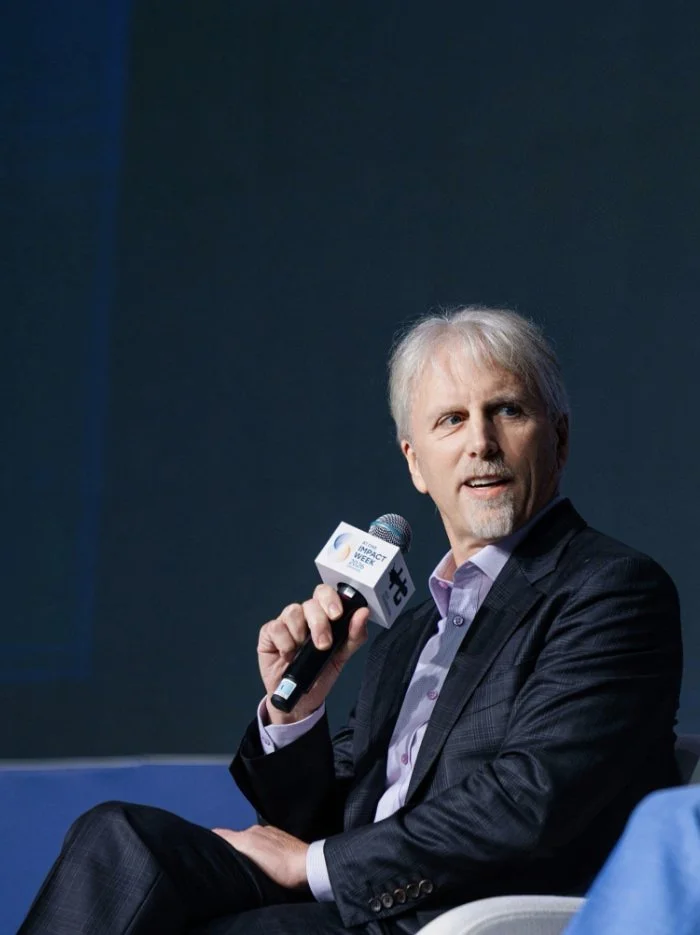
A Signpost of Hope

July 2026 | Economics of Mutuality Experts Series
Steven Garber on the Economics of Mutuality and Making Peace with the Proximate
The Economics of Mutuality (EoM) Alliance has always invited leaders to pause, resist inherited assumptions, and to ask a different set of questions. These questions are not only about growth and efficiency, but about endurance, meaning, and human flourishing. For Steven Garber, an advocate for the EoM approach for nearly two decades, this invitation resonates deeply.
Steven has spent a lifetime teaching people how to think seriously about vocation, culture, and responsibility. Across decades of work – as a teacher, writer and mentor – he has returned to one central concern: how to live truthfully in a world that is complex, fractured, and resistant to simple solutions.
When Steven reflects on EoM, he does not describe it as a silver bullet or a moral cure-all for capitalism. He has said repeatedly that he is not idealistic about social, political, or economic change. “I’m not a romantic,” he explains, “in the social, political, or cultural sense. Reality matters too much to me for that.”
What draws him instead is EoM’s willingness to rethink business without pretending that all things can be put right. As he often puts it, EoM is “a surprisingly serious effort to rethink the business of business.”
That realism also animates Steven’s most recent book, Hints of Hope: Essays on Making Peace with the Proximate. Although the essays were written over many years, the book speaks powerfully into the present moment. Its central idea – that meaningful work is almost always partial, unfinished, and fragile – has become increasingly relevant for leaders navigating economic, social, and environmental uncertainty.
Making Peace with Limits
“Making peace with the proximate,” a phrase shaped by Steven’s teachings, reflects the idea that success is rarely total. In pursuing justice and responsibility, doing what is honest and right often means accepting partial progress, rather than expecting everything to be achieved at once.
Steven’s insight is not that justice or reform are impossible, but that they are always incomplete. To stay engaged over the long term in places shaped by power, pressure, and compromise, people must accept that they can act faithfully without fixing everything. The danger, he observed, lies in believing that total resolution is possible if one just works hard enough.
He describes the myth directly: the belief that “because I’m smart, well resourced, ambitious – because nobody’s ever stopped me – I’ll get things done.” Years of observation led him to a different conclusion. “Getting all things done doesn’t happen,” he says plainly.
This insight crystallized through conversations with a South African friend who had worked as a translator for the Truth and Reconciliation Commission, a court-like body established in 1995 to help uncover the truth about human rights violations that had occurred during the period of apartheid. Immersed daily in stories of violence and trauma, his friend eventually found the work unsustainable. The question he posed to Steven – how to keep going without becoming numb or despairing – became formative.
What Steven came to see was that endurance depends on accepting human frailty. Those who stayed engaged, he noticed, were people who “lived in the tension of longing for all things to be right and well, and yet knew something of their own limits and the weariness of the world – and weren’t romantics about that, but kept at it over time.”
Why This Matters for Business
Steven sees the same tension playing out in contemporary business life. Many leaders feel pulled between short-term financial demands and a growing awareness that current systems are contributing to long-term harm, whether through social disconnection, environmental degradation, or institutional fragility.
In conversations with business leaders, Steven hears a common unease: a sense that people understand the world they want to see, but feel trapped inside the world as it currently operates.
What Steven offers is not an escape from that tension, but a way to live within it without collapsing into cynicism.
From a Question About Profit to a Shared Vision
Steven has been involved with EoM since its earliest days, before it was publicly named. His relationship with the work began nearly 20 years ago when he was invited into a breakfast conversation with Catalyst, the internal think tank of Mars, Incorporated, and senior leaders at Mars, where a deceptively simple question was asked: What is the right level of profit?
He remembers being struck not only by the question itself, but by the seriousness with which it was being asked. “I kept saying, ‘But why? Why are you asking this question?’” he recalls.
That initial conversation led to months of further dialogue, eventually giving rise to what became known as EoM. Steven has often emphasized how deliberately the work led by the Mars Catalyst team unfolded. “It took about seven years before it could even be named publicly,” he explains, “because it had to be so carefully thought through.”
Asking Different Questions
A decisive influence on this early thinking was the work of poet, essayist and novelist Wendell Berry. In his essay The Two Economies, Berry argues that dominant economic systems often obscure the real costs of production and exchange, while a more grounded economy remains attentive to land, labour, and community.
After reading Berry’s work together, Steven and others travelled to Kentucky to meet him on his farm. At the end of their time together, Berry offered a line that has since become a lodestar for EoM: if you want to make money for one year, you ask certain questions; if you want to make money for a hundred years, you have to ask different questions.
For Steven, this captures the heart of EoM. It is not anti-profit, nor is it nostalgic about markets. Rather, it asks what kind of profitability is sustainable – economically, socially, and ethically- over time. It reframes success not as extraction, but as endurance.
A Signpost, Not a Destination
Steven is careful to describe EoM not as a finished system, but as a signpost. “For me, that image really matters,” he says. “A signpost of something more honest and true and right and real.”
Steven believes 2026 represents a moment when long-standing assumptions about global order and economic cooperation are breaking down. In such a context, the temptation is either to retreat into nostalgia or to double down on ideology. EoM, at its best, offers a third way:a visionary, imaginative, serious argument for rethinking how capital, business, and society relate to one another.
This is why Steven continues to lend his voice, time, and energy to the Economics of Mutuality Alliance. Not because it promises certainty, but because it takes the world seriously as it is – and still dares to ask how it might be more honest, more just, and more humane.